Voyager 1 one light-day from Earth: what it means, in numbers
APJ-RAISE team · · 5 min read
NASA's Voyager 1 became the first human-made object to reach one light-day from Earth at 5:16:07 a.m. EST on Wednesday, 18 November 2026. That is 3:46 p.m. IST the same day. At that moment it was 25,902,068,356 kilometres (16,094,799,096 miles) away, according to NASA.
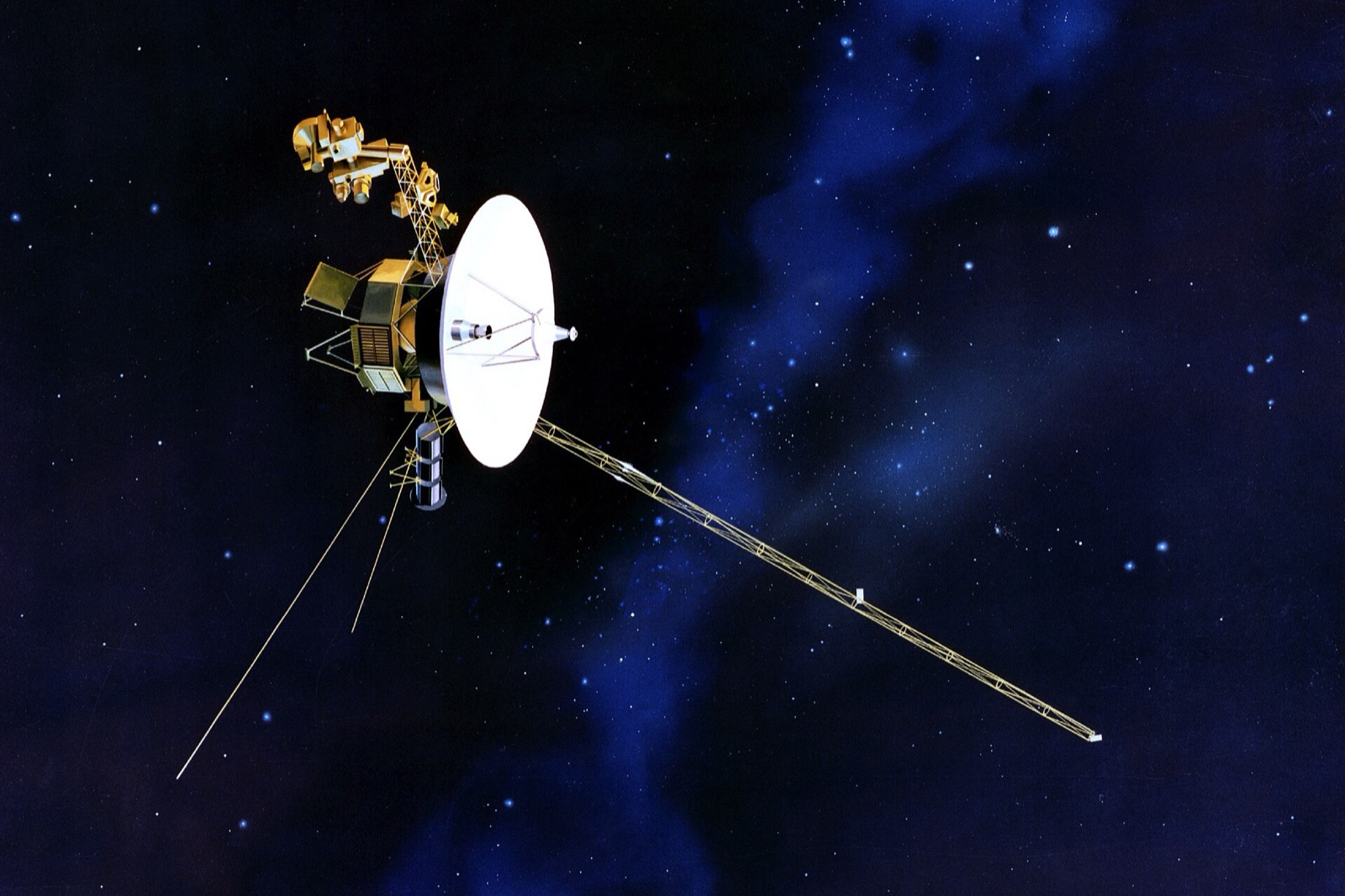
A light-day is the distance light travels in 24 hours. In practice it means a command sent from Earth now takes a full day to arrive, and Voyager's reply takes another day to come back.
Checking NASA's number ourselves
You can work out a light-day in one line. Light travels at exactly 299,792.458 km per second, and a day has 86,400 seconds.
- 1299,792.458 × 86,400 = 25,902,068,371 km. That is one light-day.
- 2NASA's distance for the moment: 25,902,068,356 km.
- 3The difference is about 15 km.
- 4Voyager 1 moves at nearly 61,000 km/h according to NASA, about 16.9 km per second. Covering 15 km takes it under one second.
So the small gap is not an error. NASA rounded the milestone to the whole second, 5:16:07, and in the fraction of a second left over, Voyager had not quite reached the line. It is a neat example of how a quoted number carries hidden choices, here the choice to round time instead of distance.
How long does a message to Voyager 1 take?
Exactly as long as the name says: about 24 hours one way, 48 hours for a round trip. If engineers spot a problem and send a fix, the earliest they can see whether it worked is two days later. Every operation is planned around that delay.
What is still working on Voyager 1?
Voyager 1 launched on 5 September 1977 and crossed into interstellar space in August 2012. It runs on a slowly fading power supply, so the team has switched instruments off one by one. NASA's status table, last updated in April 2026, lists just two science instruments still on:
- Magnetometer: on. It measures the magnetic field of interstellar space.
- Plasma wave subsystem: on. It senses the thin gas between the stars.
- Cosmic ray subsystem: switched off to save power in February 2025.
- Low-energy charged particle instrument: switched off in April 2026.
- Cameras: off since February 1990, shortly after the "Pale Blue Dot" photo of Earth.
How far is that, really?
One light-day sounds huge, and it is: about 173 times the distance from Earth to the Sun. But the stars are much further. Our own rough sum: the nearest star, Proxima Centauri, is about 4.25 light-years away. At 16.9 km per second, Voyager 1 would need roughly 75,000 years to cover that distance, and it is not even heading that way.
Voyager 2, its twin, travels a little slower. NASA expects it to reach one light-day in November 2035.
Why this matters for students
Voyager is still doing science 49 years after launch, with hardware designed in the early 1970s. That is a lesson in engineering margins and careful planning, and in how much one dataset can be worth when nobody else can collect it. The light-day check above is also a model for reading any headline number: redo the sum, and if it does not match, work out why before you call it wrong. Our free course on research foundations teaches that habit. For more space science, see our post on the IceCube Nobel Prize. At APJ-RAISE, students work through real data together. Joining is free.
Questions people ask
- When did Voyager 1 reach one light-day from Earth?
- At 5:16:07 a.m. EST on 18 November 2026 (3:46 p.m. IST), according to NASA.
- How far is one light-day?
- About 25.9 billion km (16.1 billion miles), the distance light travels in 24 hours.
- How long does it take to talk to Voyager 1?
- About 24 hours for a signal to reach it and another 24 hours for its reply, so 48 hours for a round trip.
- Is Voyager 1 still working?
- Yes. As of NASA's April 2026 status table, its magnetometer and plasma wave instrument are still on. Other instruments have been switched off to save power.