Five-dimensional Black Saturn spacetime: what news got wrong
APJ-RAISE team · · 6 min read
A Black Saturn is a solution of Einstein's equations in five-dimensional spacetime: a round black hole with a separate, donut-shaped black hole (a black ring) circling it. On 16 November 2026, Jay Armas posted a preprint on arXiv, Doubly-spinning Black Saturns, which lets both objects spin in two independent planes at once. ScienceAlert covered it on 21 November, and searches for "five dimensional black saturn spacetime" jumped soon after.
It is maths, not an observation. Nobody has seen a Black Saturn, and there is no evidence that our universe has a fifth large dimension. The paper is also a preprint, so it has not been through peer review yet.
What is a Black Saturn?
In our familiar four-dimensional spacetime (three space directions plus time), a black hole with no charge is fully described by its mass and spin. Its horizon is always round. Physicists call this uniqueness.
Add one more space direction and uniqueness breaks. In 2002, Roberto Emparan and Harvey Reall found a five-dimensional black hole shaped like a ring. In 2007, Henriette Elvang and Pau Figueras went further and built Black Saturn: a spherical black hole with a black ring around it, both sitting in otherwise empty space. The name comes from the picture, a planet with a ring.
The 2007 solution had a limit. Both horizons could rotate in one plane only. Elvang and Figueras listed a doubly spinning version as an open problem in their own abstract. Armas's preprint answers that problem nineteen years later.
Why does five-dimensional spacetime allow two spins?
A small count, which you can check yourself, explains it. A rotation always happens in a plane, and each independent plane needs two space directions of its own. So the number of independent rotation planes is the number of space dimensions divided by two, rounded down.
- Our universe, 3 space dimensions: 3 ÷ 2 rounds down to 1. One rotation plane, one spin.
- Five-dimensional spacetime, 4 space dimensions: 4 ÷ 2 = 2. Two independent planes, two spins.
- Ten-dimensional string theory spacetime, 9 space dimensions: 4 planes.
That second spin is the whole story of the new paper. In four space dimensions an object can turn in the x–y plane and, separately, in the z–w plane, at different speeds. A ring can also spin around its own circle and twist through the other plane at the same time.
What did the new preprint find?
The arXiv abstract makes four claims. We paraphrase them here.
- 1A six-parameter family of exact solutions of five-dimensional vacuum gravity: a spherical black hole plus a black ring, each rotating in both planes.
- 2In one regime both horizons can be extremal at once. The author calls this the first regular, asymptotically flat vacuum solution with two separate extremal horizons.
- 3Non-extremal Black Saturns can reach thermodynamic equilibrium, meaning the two horizons share a temperature and rotation speed. The doubly extremal version cannot.
- 4Known solutions come back as limits: the doubly spinning Myers–Perry black hole, the doubly spinning Pomeransky–Sen'kov black ring, and the 2007 singly spinning Black Saturn. The results also match earlier approximate predictions from the blackfold method.
The third point is a good check of any new solution. If the old answers do not fall out when you switch parameters off, something is wrong.
What does extremal mean for a black hole?
A spinning black hole cannot spin without limit. At the maximum spin for its mass, its Hawking temperature drops to zero. That limit is called extremality.
In five dimensions there is a twist. A black hole spinning in only one plane loses its horizon as it approaches that limit. It needs spin in both planes to reach zero temperature and still keep a horizon. So a singly spinning Black Saturn could never have two extremal horizons. A doubly spinning one can, and that is why the new solution matters to theorists.
One more effect shows up. A spinning ring drags spacetime around with it, an effect called frame dragging. ScienceAlert notes that this can make the central horizon rotate even in a plane where the central black hole carries no angular momentum of its own.
Is Saturn a black hole? How big would it be if it were?
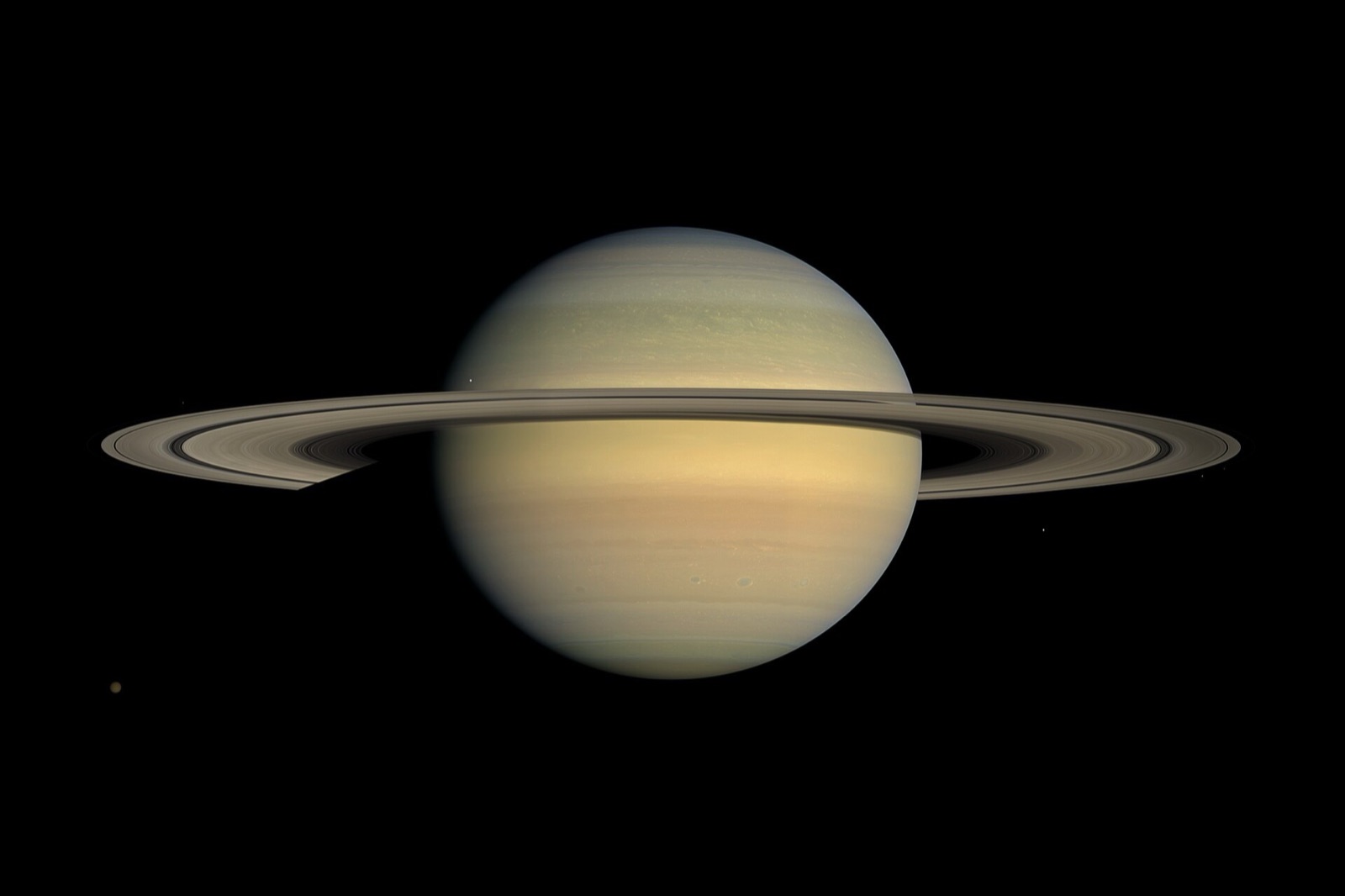
No. Saturn is a gas giant planet, and the name Black Saturn only borrows its ring-and-planet look. Saturn could not become a black hole on its own either: it has far too little mass to collapse.
It is still a fun calculation, and you can check ours. Any mass M becomes a black hole if it is squeezed inside its Schwarzschild radius, r = 2GM/c². With Saturn's mass of 5.68 × 10²⁶ kg, G = 6.674 × 10⁻¹¹ and c = 3.00 × 10⁸ m/s:
- r = 2 × 6.674 × 10⁻¹¹ × 5.68 × 10²⁶ ÷ (3.00 × 10⁸)² ≈ 0.84 metres.
- So a Saturn-mass black hole would be about 1.7 metres across, roughly the height of a person.
- Saturn today is about 60,000 km in radius, so it would have to shrink around 70 million times.
- Saturn is so puffy now that its average density, about 0.6 g/cm³, is less than water.
One more surprise: Saturn's moons would keep orbiting as before. From outside, gravity depends on mass, not size, so a Saturn-mass black hole pulls on Titan exactly as Saturn does. The rings, which also orbit outside the planet, would keep circling too, now around something the size of a person.
What some coverage got wrong
- Not "a black hole inside a black hole". Some headlines say this. The ring circles the central black hole at a distance. Each has its own separate horizon, and neither is inside the other.
- Not a discovery in space. It is an exact solution of equations. It tells us what gravity allows in five dimensions, not what exists.
- The 2007 reference. The original Black Saturn paper is JHEP 0705:050 (DOI ending 2007/05/050). The ScienceAlert article links a DOI ending in 056 instead, which we think is a typo.
Why do physicists study five-dimensional black holes?
Extra dimensions come up in string theory and in models of quantum gravity. Even without them, higher dimensions are a test bench. Changing the number of dimensions shows which features of black holes are deep and which are accidents of living in four. Uniqueness, it turns out, is one of the accidents.
Five dimensions are also the first place where exact solutions are still possible. With two spins and a few symmetries, the equations can be solved with tools such as the inverse scattering method that Elvang and Figueras used. In six or more dimensions, physicists mostly fall back on approximations like blackfolds, the method the new paper checks against.
How students can read this paper
The preprint runs to about 30 pages plus appendices, under a CC BY 4.0 licence, so it is free to read and reuse. Start with the 2007 Black Saturn paper, which has many figures and a gentler pace. Then read the abstract and conclusions of the new one, before the derivations. Our three-pass method for reading a research paper fits this well: the first pass is for what is claimed, the second for the figures, and the third for the maths.
Treat the result as provisional until it passes peer review. Our free Publishing and Peer Review course explains what review checks and what it misses. For another recent case of hard maths making news, see our post on the Navier–Stokes AI proof. At APJ-RAISE, students read papers like this together. Joining is free.
Questions people ask
- Is Black Saturn real?
- It is a real solution of Einstein's equations in five-dimensional spacetime, but it has never been observed. There is no evidence that a fifth large dimension exists in our universe.
- Can a black hole have a ring?
- Not in our four-dimensional spacetime, where black holes are always round. In five dimensions a black hole can itself be ring-shaped (a black ring, found by Emparan and Reall in 2002), and in a Black Saturn that ring circles a second, round black hole.
- Are black holes 5 dimensional?
- The black holes astronomers observe live in ordinary four-dimensional spacetime. Five-dimensional black holes, including Black Saturns, are solutions of Einstein's equations that physicists study in theory. None has been observed.
- What is new in the 2026 Black Saturn paper?
- Jay Armas's preprint (arXiv:2611.20701) lets both the central black hole and the ring spin in two independent planes. The 2007 original allowed only one. Both horizons can also reach zero temperature at once.
- How big would Saturn be if it was a black hole?
- About 1.7 metres across. Saturn's Schwarzschild radius, 2GM/c², works out to roughly 0.84 metres, around 70 million times smaller than the planet is today.
- Who discovered Black Saturn?
- Henriette Elvang and Pau Figueras in 2007 (JHEP 0705:050). The doubly spinning version is in a November 2026 preprint by Jay Armas, arXiv:2611.20701.
- Why can things spin in two planes in five dimensions?
- Each rotation plane needs two space directions. Five-dimensional spacetime has four space directions, which gives two independent planes.
Sources
- 1.Armas, J. (2026). Doubly-spinning Black Saturns. arXiv:2611.20701 (preprint, not peer reviewed).
- 2.Elvang, H. and Figueras, P. (2007). Black Saturn. JHEP 0705:050. arXiv:hep-th/0701035.
- 3.Emparan, R. and Reall, H. S. (2002). A rotating black ring in five dimensions. Phys. Rev. Lett. 88, 101101. arXiv:hep-th/0110260.
- 4.Starr, M. (21 Nov 2026). Physicist Finds a Strange New Solution to Einstein's Equations in Five-Dimensional Spacetime: Black Saturn. ScienceAlert.